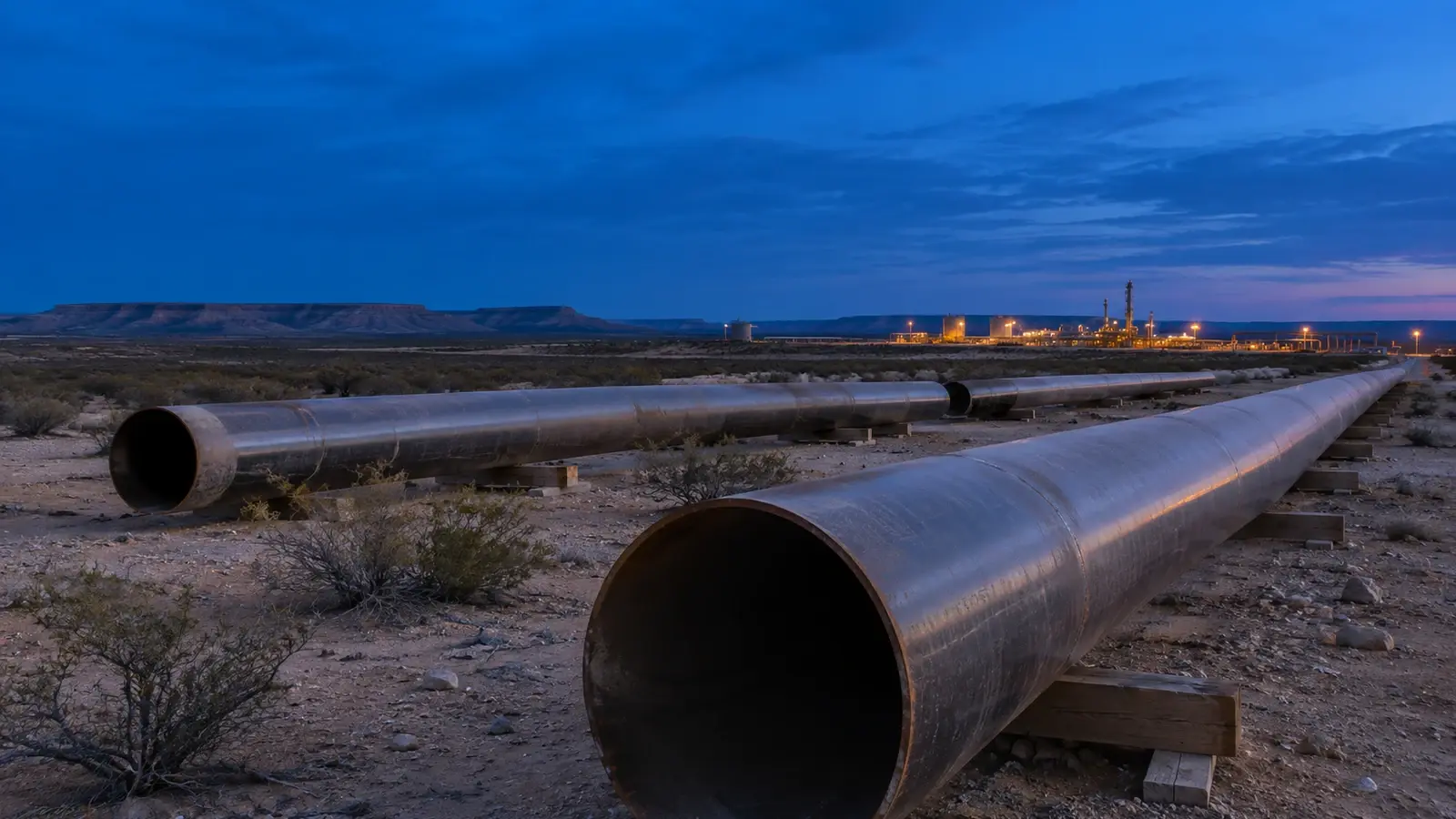
The Federal Energy Regulatory Commission has issued certificates for the Forza Project, authorizing a new interstate natural gas route designed to move up to 750,000 dekatherms per day from the Delaware Basin in southeastern New Mexico toward pipeline connections near the Waha Hub in West Texas.
The November 19 order covers Forza Pipeline LLC and related authority for Bull Run Pipeline LLC. FERC authorized Forza to construct and operate the project, subject to the order's conditions. The certificate authority begins with a 30-day stay and can remain stayed while FERC addresses any timely rehearing requests from affected landholders. Separate written authorization from FERC staff is required before construction begins and again before the facilities enter service.
Key numbers
- 35.94 miles: The new 36-inch-diameter pipeline would run from Desert Ram Junction in Lea County, New Mexico, to Wildcat Junction in Winkler County, Texas.
- 750,000 Dth/day: The project's maximum planned firm transportation capacity.
- 87% committed: FERC said signed agreements cover about 650,000 Dth/day. Targa Gas Marketing accounts for 500,000 Dth/day, and Devon Energy accounts for 150,000 Dth/day.
- 43 additional miles: Forza's service would use capacity on Bull Run's completed 42-inch extension between Wildcat Junction and the Waha Hub in Pecos County, Texas.
- Early 2028: Targa's current project page targets operations for early 2028, following an expected construction start in mid-2027. FERC's order requires the authorized facilities to be completed and available for service within two years of November 19, 2026.
The new segment would begin where residue outlet lines from Targa's Red Hills processing plant and planned Copperhead plant meet at Desert Ram Junction. The route would cross Lea County, New Mexico, and Loving County, Texas, before reaching Winkler County, Texas. Planned facilities include a new meter station at the origin, a mainline valve in Loving County, and pipeline-operation equipment at Wildcat Junction.
Why it matters for Delaware Basin stakeholders
Natural gas produced alongside oil must move through gathering, processing and long-distance transportation systems before it can reach major demand centers. When residue gas leaving processing plants has too few outbound routes, transportation limits can affect how reliably growing basin volumes reach downstream pipelines.
Forza is designed to add an outlet between two Delaware Basin processing sites and the dense network of connections around Waha. FERC's order said the Red Hills and Copperhead plants' potential output could exceed currently available takeaway capacity at that location. The agency concluded that the project would ease existing and anticipated constraints in the producing region.
The operational value is not simply delivery into Waha. Waha serves as a transfer point with multiple pipelines that continue toward other Texas markets. FERC said the planned path would give shippers access through those interconnections to Gulf Coast liquefied natural gas facilities, power generators and other demand centers. Targa likewise describes the project as a connection from New Mexico processing facilities to intrastate and interstate systems near Waha and in Winkler County.
That added connectivity can give processed Delaware Basin gas another path out of the production area. It does not guarantee a particular market outcome: actual effects will depend on construction progress, available downstream space, shipper nominations, basin production and demand across connected markets.
What to watch
The first milestone is the status of the certificate stay and any rehearing activity. Even after the stay ends, Forza must satisfy the order's preconstruction requirements, secure applicable federal authorizations and obtain a written notice to proceed from FERC environmental staff.
Construction timing is another key marker. Targa says it expects work to begin in mid-2027 and operations to start in early 2028. The FERC record also describes a roughly ten-month construction period. Schedule updates will show whether field work remains aligned with that target.
Stakeholders can also watch filings that confirm the committed transportation contracts before construction, followed by FERC status reports during building and restoration. Finally, the in-service request will matter because FERC staff must determine that required rehabilitation and restoration work is proceeding satisfactorily before authorizing operations.
If the project reaches service as planned, its practical test will be whether the new Desert Ram-to-Wildcat route consistently moves Delaware Basin residue gas into the Waha-area network and onward to the downstream markets identified in the federal record.